How to make $$$ hosting in-person AI workshops
EVERYONE is sleeping on this offer because it's not what 99.9% of people think of when they think "make money with AI".
EVERYONE is sleeping on this offer because it's not what 99.9% of people think of when they think "make money with AI".
Most people are trying to build an agency, a SaaS, or an app but the single biggest opportunity to make money with AI is hiding in plain sight.
My friend @Markfersh raised $8 million and spent seven years building a B2B SaaS to a $500K annual run rate.
Six months of nights-and-weekends AI consulting passed that number.
He shut the SaaS down. And one of the offers driving the consulting side is the least technical thing on his menu: in-person AI workshops. The first one he ran was $495 a head, four hours, 15 people, marketed with an Eventbrite listing and a handful of LinkedIn DMs.
In this article:
- Why Mark treats the workshop as a lead magnet he happens to get paid for, not the product
- The four-rung offer ladder, with his real prices at every rung
- The 20% pricing rule he uses to set workshop fees
- The math behind why workshops cap out and builds don't
- How to run your first one with no audience and no technical background
- The three ways this model breaks
Almost nobody is doing this right now. Most operators are fighting over Zoom calls and DMs while a 45-plus business owner two miles from you is embarrassed to ask what a "skill" is and would pay to find out in a room.
Before we dive in, I bundled the complete Workshop Wedge systeminto one free doc: the 4-hour workshop agenda, the pricing worksheet, the Eventbrite listing template, the opportunity log, and the post-workshop upsell script.
Let's get into it.
The positioning shift: the workshop is not the product
Here's the line from Mark that reframed the whole model for me:
"I don't think the in-person workshop is the full value. It's getting your foot in the door. It's a lead magnet that you happen to make some money off of."
Most people who hear "AI workshop" picture the workshop as the business. Book them, deliver them, repeat. You can make a living that way. Mark's estimate is that you cap out at a couple hundred thousand a year, because workshops eat hours. Planning, delivery, and by his own account, he's wiped for days afterward.
So he uses the room differently. A workshop gets him in front of a whole team for 4-8 hours, with permission to ask about every process they hate. By the end, he has a list of expensive problems, a warm relationship, and the right to propose the build.
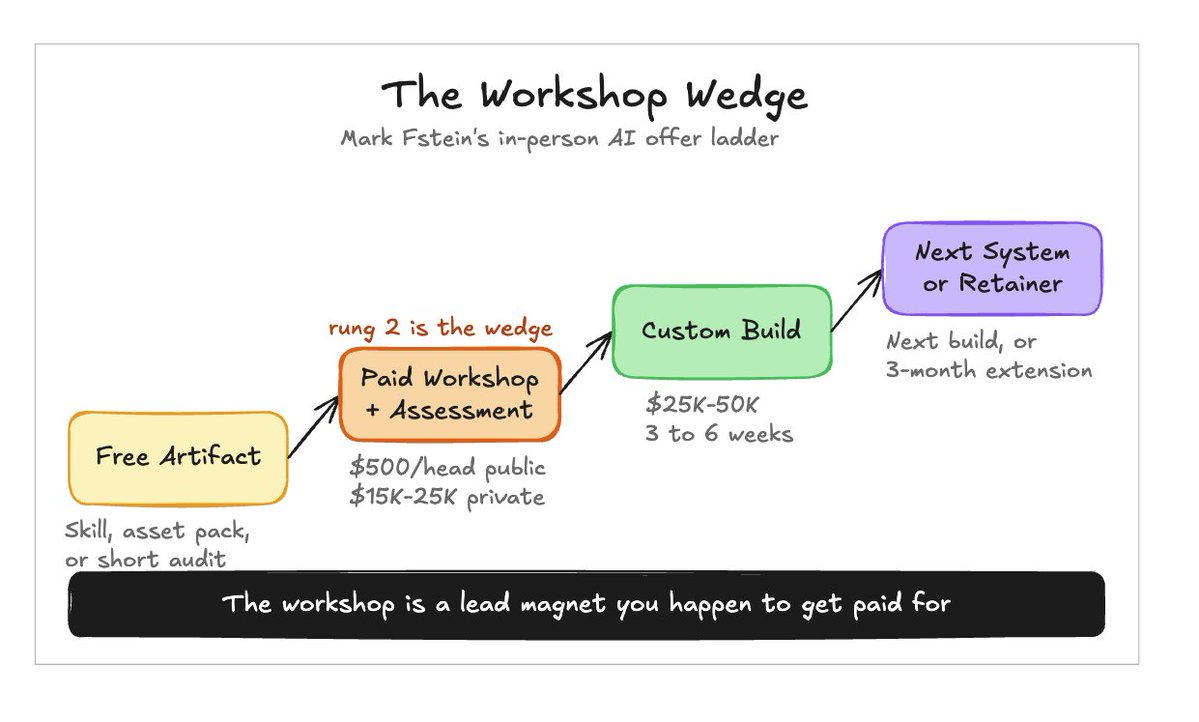
I'm calling this the Workshop Wedge: a paid, in-person session that opens the account, surfaces the real problem, and sets up a larger implementation deal. Four rungs.
Rung 1: the free artifact
Mark gives away as much as he can up front. A Claude skill, a bundle of assets, a short audit. Something the prospect can use today.
The point is trust before money. If you're targeting a company, this is what gets the workshop conversation started. If you're running a public workshop, this is your content on LinkedIn or X that makes someone click the Eventbrite link.
Sometimes there's a half step here: a paid audit. If he's going into a team, he'll diagnose their problems first and then tailor the workshop to what he found. That audit is also where the assessment in "workshop plus assessment" comes from.
Rung 2: the paid workshop
Two flavors, two price points.
Public, per head. His first was $495 a person, four hours, 15 attendees. Rough math: around $7,400 for an afternoon, before venue costs. The audience skewed 45 and older, people who were afraid of being left behind at work and didn't want to ask in front of their team.
Private, per company. Half a day to two days, $15K to $25K. Formats he's run: a team AI essentials session, a hackathon where he teaches the basics and then the group spends four or five hours building with Claude Code and Cowork together, and a "everyone leaves with an agent built" session.
I asked him directly about pricing because I'm in the middle of this myself. Two days before we recorded, my realtor here in Charlotte asked me to run a paid workshop for her brokerage. Every realtor is an independent contractor, so nobody's boss foots the bill. My gut said $500 a head.
Mark's answer: right in range, and don't go higher than you have to.
"You can make mistakes at $500. You probably can't make mistakes at $2,000 a head."
His logic is that a $500 attendee leaves saying "that was a bargain" and refers three friends. A $2,000 attendee scrutinizes every minute. For a first workshop, you want the referral, not the margin.
Here's the pricing rule he uses for the private ones:
WORKSHOP PRICING WORKSHEET

1. Name the workflow(s) the workshop will change.
2. Estimate the annual value if they adopt what you teach:
   - Low case (25% adoption):   $______
   - Mid case (50% adoption):   $______
   - Best case (full adoption): $______
3. Price the workshop at roughly 20% of the mid case.
4. Sanity check against the ceiling: a CEO of a 150-person company
   can pay multiples of what a 5-person shop can, for the same content.
5. Public per-head events: start at $500. Raise only after you have
   a referral loop, not before.
That's Mark's rule of thumb, not a formula he's audited. But it explains why the same four hours are $500 a head in one room and $25K in another.
Here's the listing template. Full version in the bundle.
PUBLIC WORKSHOP LISTING TEMPLATE

Title: AI for [Industry/Persona]: Build Your First [Agent/Skill] in 4 Hours

Who it's for: [Persona] who use ChatGPT sometimes and know they're
barely scratching the surface.

What you'll leave with:
- One working [agent/skill/automation] built during the session
- The exact prompts and setup we used, in a shared doc
- A list of the 3 workflows in your business to automate next

Format: In person. 4 hours. Laptop required. Max [15] seats.
Price: $[495]. Paid up front.
Host: [Your name], [one-line credibility: what you've built or sold].
Rung 3: the custom build
This is where Mark says the money and the fun are.
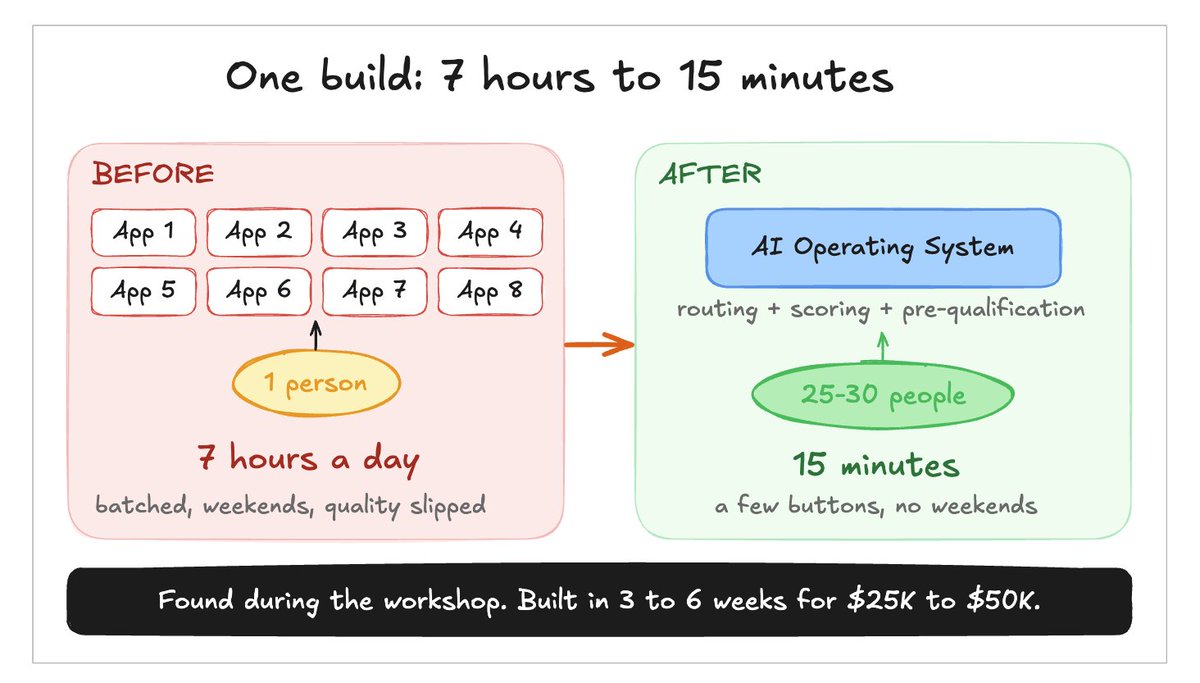
$25K to $50K, three to six weeks. And he's clear that's the low end. He's been pulled toward mid-market and enterprise, with several six-figure proposals out right now. Those are bundles: assessment, workshop, training, build, and sometimes a short retainer, on one contract.
What he builds: what he calls an AI operating system. A context layer that connects three to five of their existing tools and their internal knowledge base into one place. His last startup did this for sales teams. Now he builds custom versions.
The receipt he gave: a client had one brilliant person spending seven hours a day on internal staffing, bouncing across eight platforms. Work got batched, spilled into weekends, quality slipped. Mark's build added routing, scoring, and pre-qualification logic behind a few buttons. Staffing dropped to about 15 minutes, and 25 to 30 people can run it now instead of one.
Seven hours to 15 minutes is the sales pitch for rung three. The workshop is where he found it.
How the workshop finds the build
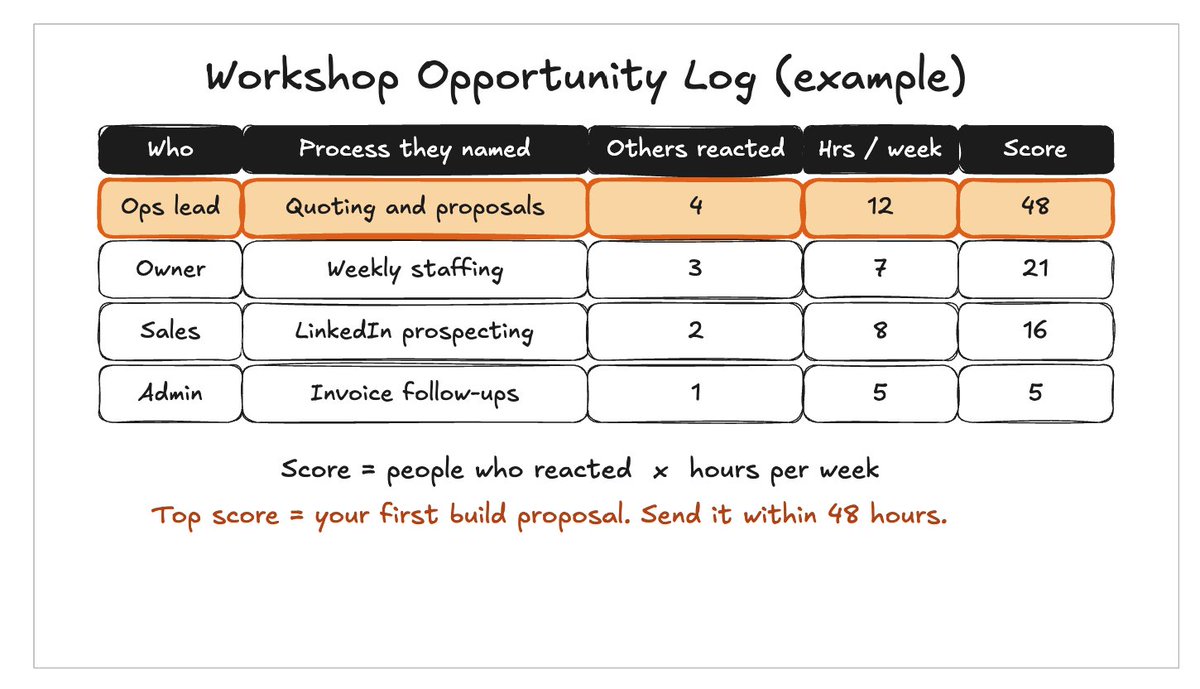
Mark writes something down every time this happens: in the middle of a session, someone on the team nudges the person next to them and says "we could do this for our quoting process." Three other people say "I was thinking the same thing."
That's the first build. I'm calling it the elbow test. If a process makes people elbow each other, it's expensive enough to pay for.
WORKSHOP OPPORTUNITY LOG

During every workshop, capture:

| Time | Who said it | The process they named | Who else reacted | Hours/week it eats (ask) |
|------|-------------|------------------------|------------------|--------------------------|
|      |             |                        |                  |                          |

After the workshop, rank by (people who reacted) x (hours/week).
The top row is your build proposal. Send it within 48 hours while
the room is still warm.
Rung 4: the next system and the retainer
After the first build, it branches.
Sometimes it's another workshop for a different team: engineering, customer success, a security and governance session for leadership. Sometimes it's the next build. Sometimes it's a retainer, and Mark's experience is roughly 50/50 between clients who want him for another three months and clients who want one big package, paid half up front and half on completion.
He doesn't chase maintenance fees. His view: if he's collecting maintenance, he failed at training the trainer. He'd rather parachute in, ship, hand off, and leave. So the retainer, when it exists, is for building the next thing, not babysitting the last one.
The math behind the ladder
Here's why the ladder matters more than any single rung.
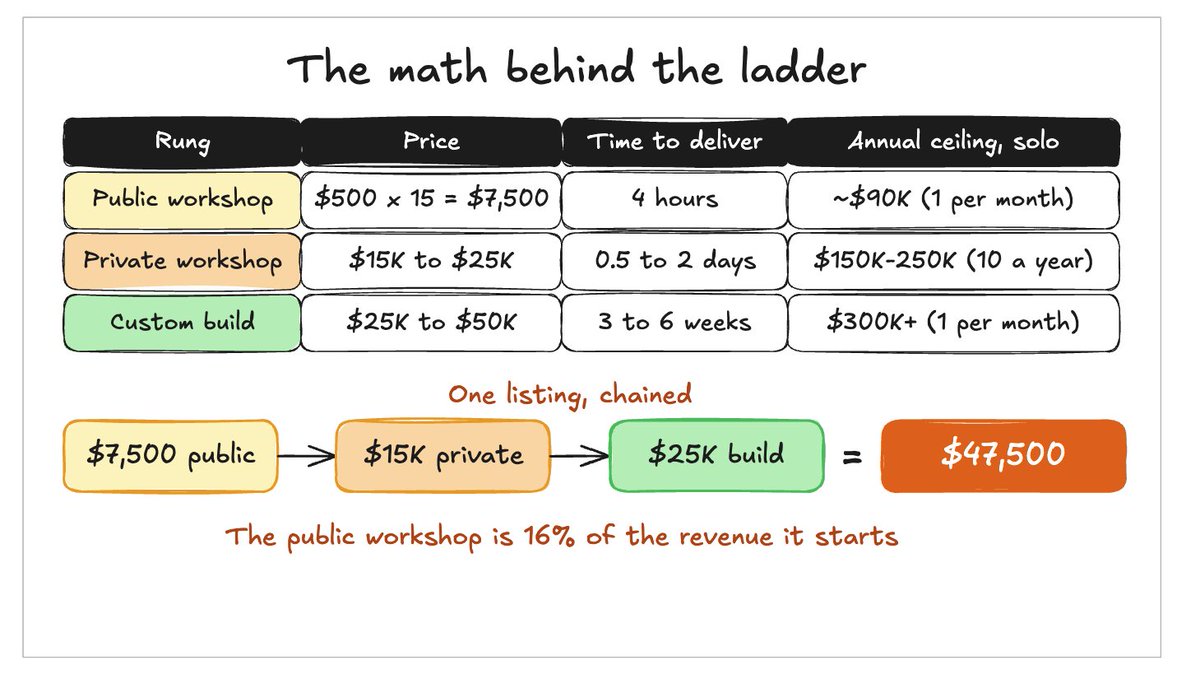
Public workshop: $500 x 15 people = $7,500 for a day. Do one a month and it's $90K a year, and that's your ceiling if every seat fills.
Private workshop: $15K to $25K for one to two days. Ten of those is $150K to $250K. Still a ceiling, and you're cooked for a week after each one.
Build: $25K to $50K over three to six weeks. One build a month at the low end is $300K a year, and each one came from a workshop you already got paid for.
So the sequence, using Mark's low-end numbers: $7,500 public workshop, which produces one private workshop at $15K, which produces one build at $25K. That's $47,500 from one Eventbrite listing. The public workshop is 16% of that revenue.
He turns down workshops that don't have upsell potential, and he's said he could run far more if he weren't doing the bigger builds. But the shape holds: the workshop is the smallest check in the chain and the one that opens up the rest.
Getting your first workshop
Mark's advice for someone who's never run one: don't overthink it.
Three steps.
Pick a niche you already know. Mark's biggest regret is being too broad. Every one of his seven offers could be its own business, and now he has to choose. If you spent ten years in real estate, dental, roofing, or e-commerce, run "AI for [that]."
I have an Amazon wholesale background. I could charge $1,000 to $2,000 a head to Amazon sellers and deliver more than I could to realtors, because I know what their week looks like.
Run one public, paid, in person. Eventbrite listing, Stripe up front, $500 a head. DM everyone you know in the area and ask who else should be there. If two people show up, you made money and they got the best workshop of their life. Worst case, you're out a couple hundred bucks on a room.
Don't teach everything. Mark's point that I keep coming back to: we live in a bubble. Most people's entire AI experience is typing into ChatGPT. They don't need 27 agents. They need Cowork or ChatGPT set up, two or three skills built, a couple of scheduled tasks, and a clear answer to "what's eating hours of your week that you hate?" That's the 80/20.
4-HOUR WORKSHOP AGENDA

0:00  Why this matters for [persona]: 3 real examples from your niche
0:20  Setup: everyone gets Claude/Cowork or ChatGPT working on their laptop
0:50  Build 1 (together): a skill for the task everyone in the room hates
1:40  Break
1:55  Build 2 (solo, you float): each person picks their own workflow
2:45  Scheduled tasks: set up one recurring job per person
3:15  Opportunity round: "what else could this do for you?" (log everything)
3:45  Close: what's next, how to get help, the offer for teams
Then the upsell. Mark guarantees that if you do a great job, people will come up afterward and ask if you can do this for their company. Say yes.
UPSELL SCRIPT (after the workshop)

When someone asks "can you do this for my team / my company?":

"Yes. Here's how I'd run it: half a day with your team, we build
around the workflow you just described, and I leave you a list of
what to automate next. That's $[15K].

If I haven't built exactly that before, I'll say so. And if you'll
let me use it as a case study, I'll do it for $[10K]."
Be upfront about what you haven't done. Trade a discount for a case study. That's how you go from one public workshop to your first private one without an audience.
Who this is for, and who it isn't
This is for you if you can build, or you're confident you can learn to build what you'd teach. You have a niche or an industry you know cold. You're comfortable in a room. Bonus points if you have an events or events-marketing background, because filling seats is half the job.
This isn't for you if you want fully remote, zero-travel work. It's not for you if you'd rather sell a $5K workshop and disappear; the model only pays off if you deliver well enough to earn the upsell. And it's not for you if you can't say "I've never done that, but I'm confident I can" with a straight face.
Three ways this model breaks
1. Selling workshops to teams that don't need you. Mark turned down a company that was already good at AI. They negotiated hard on price and he could see no upsell behind the workshop. If a team has real internal builders, you're a one-time line item. Qualify for "one person is the AI expert and everyone else is behind."
2. Overdelivering on complexity. Teaching a room of 50-year-old business owners about agent loops and orchestration is how you lose them in the first hour. The value is in simple, real jobs to be done. Tools are almost irrelevant. Workflows are the whole thing.
3. Treating the workshop as the finish line. If you walk out with a check and no opportunity log, you ran a class, not a wedge. The 48-hour proposal after the session is where the money is. Skip it and you've capped yourself at a couple hundred grand a year with the hardest possible schedule.
The first 10 actions I would take
- Pick the industry or persona you know best. One. Not "small business."
- Write down the three workflows in that niche that waste the most hours per week.
- Build a free artifact that solves one of them (a Claude skill, a prompt pack, a checklist). Post it.
- Create an Eventbrite listing using the template above. $500 a head, four hours, 15 seats max.
- Stripe or Eventbrite payments up front. No pay-at-the-door.
- DM 20 people in your area and ask who else should be there.
- Run the workshop off the agenda above. Two builds, one scheduled task, one opportunity round.
- Fill the opportunity log during the session. Every elbow moment gets a row.
- Within 48 hours, send the top opportunity as a private workshop or build proposal, priced with the 20% rule.
- Take the case-study discount on the first private one if it gets you in.
- After the private workshop, propose the build. $25K to $50K, three to six weeks.
- Turn down the next workshop that has no upsell behind it.
Final thoughts
Mark raised $8 million to build a product. The thing that out-earned it was standing in a room showing people how to use Claude.
His numbers are his, from six months of part-time experiments, and he'd be the first to say he's still figuring out which rung to double down on. But the shape is what matters: the free thing earns the room, the room earns the problem, the problem earns the build.
If you want the complete Workshop Wedge system, I bundled the agenda, the pricing worksheet, the listing template, the opportunity log, and the upsell script into one copy-paste doc.
You can find Mark at masteringai.io or on X @markfersh. The full interview with Mark is here.
Follow me @coreyganim for daily posts on growing an AI services business. And if this was useful, repost it so another operator sees it.
Landing a $30K retainer through an AI workshop
Dino Watt explains the workshop, paid assessment, and consulting path in the interview.