5 Github repos that print $$$
Ten clients on one free open-source repo is roughly $3,000 a month in recurring revenue for about 10 hours of work. The software costs you nothing. The buyer never needs to know what a GitHub repo is.
Ten clients on one free open-source repo is roughly $3,000 a month in recurring revenue for about 10 hours of work. The software costs you nothing. The buyer never needs to know what a GitHub repo is.
I've spent the last year selling AI services to non-technical business owners and teaching 300+ people inside AI Operator Academy to do the same. The pattern that keeps working is simple: you don't sell AI. You sell one specific outcome, and something free does the work underneath.
In this article:
- The four-part stack every one of these offers runs on
- Five repos, and for each one: what it does, what you sell, who buys it, an honest price, and where the leads come from
- The exact tool I use to pull verified buyer contacts straight from Claude
- The math behind the first $2K/month
- The proof-first cold email that earns the pitch
- Three ways this model breaks
- The first 10 actions I'd take starting tonight
Almost nobody is doing this yet, because the people who can run these repos don't sell, and the people who sell don't know the repos exist.
Before we start, I bundled the repo links, the prompts that build the offer for you, and the cold email templates into a free resource that lives inside AI Operator Hub.
You can access the hub here (free).
I also recorded an entire video breaking down these 5 repos in detail that you can watch here.
Let's get into it.
The positioning shift: nobody buys a repo
Every offer in this article runs on the same four layers. I call it the Repo-to-Retainer Stack:
- Repo. A free open-source project that does the heavy lifting.
- Runner. Claude Code installs it, configures it, and runs it. You give plain-English instructions.
- Result. The one outcome the business owner actually pays for. Not "AI." Not "a chatbot." A rival's price drop in their inbox within minutes.
- Reach. A people-search tool called treg that plugs into Claude and finds the exact buyer for that result.
Get all four right and you have a productized service you can sell over and over.
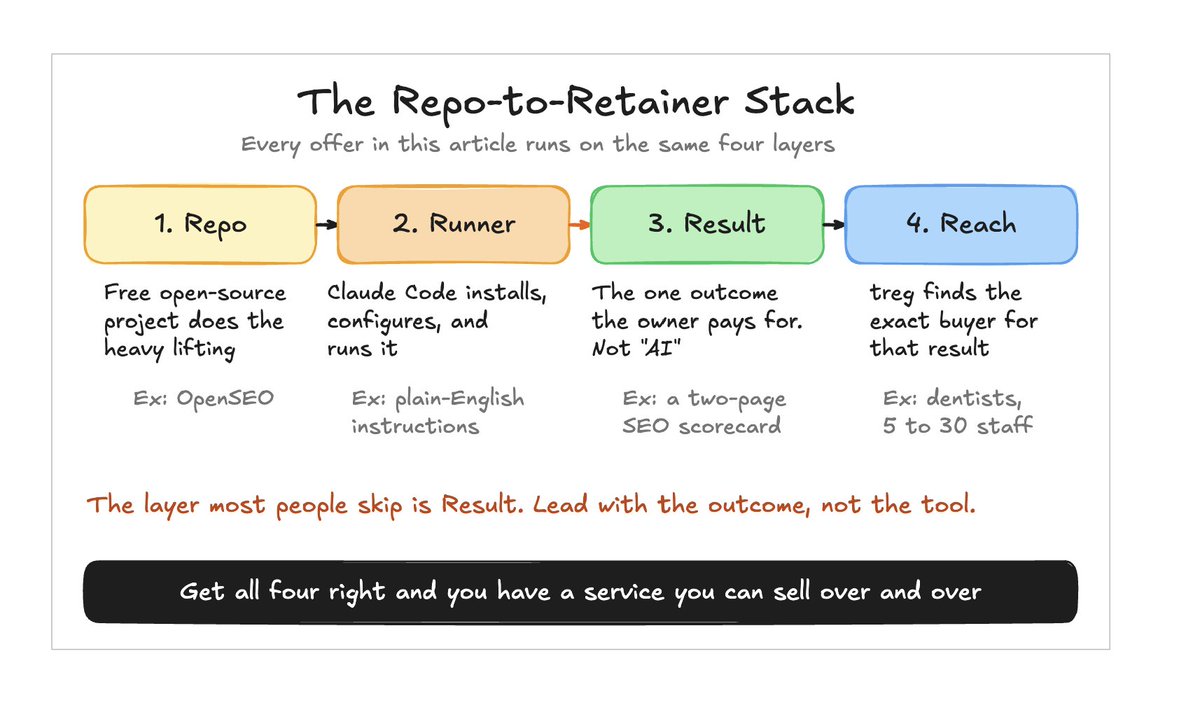
The layer most people skip is Result. They lead with the tool, the owner hears "open-source scraping framework," and tunes out.
Lead with the outcome. Every time.
The five repos
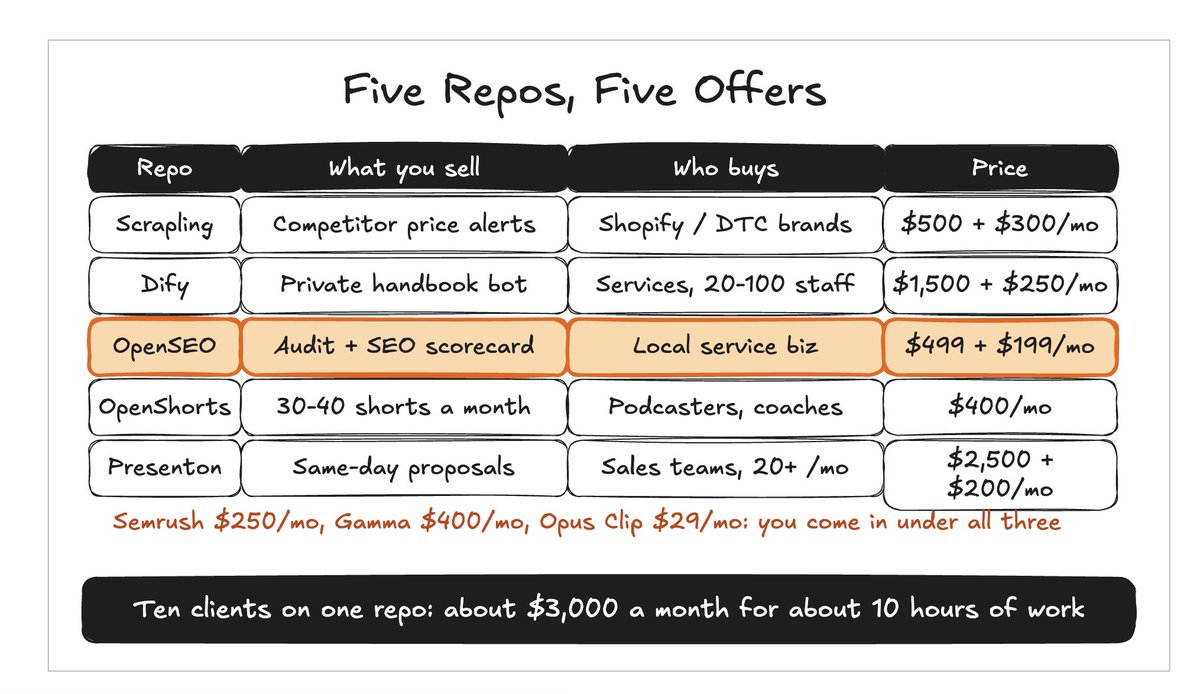
Every price below is what I'd charge today. Treat them as targets, not proven pricing on every offer.
1. Scrapling: the weekly competitor price and stock report
What it does. Scrapling is a free scraping framework that gets past bot walls and keeps working when a site changes its layout. Most scrapers break the day a competitor redesigns a product page. This one doesn't.
What you sell. A weekly competitor price and stock report. You scrape five of the client's rivals into a Google Sheet and alert them every time a price drops or a product sells out.
Who buys. Shopify and DTC brand owners with 50 to 500 SKUs, doing $1M to $10M a year, with 3 to 5 named competitors.
Price. $500 setup, $300 a month. Your cost is roughly $40 a month for proxies and a small server (an estimate, not an audited number).
Where the leads come from. treg finds companies running Shopify with 5 to 50 US employees, filtered to founder, owner, or e-commerce manager. Send them a screenshot of one rival's actual price drop, captured with Scrapling, before you ask for anything.
Ten clients: about $5,000 in setup fees and $3,000 a month recurring, for roughly 10 hours a month of upkeep.
2. Dify: the private handbook bot
What it does. Dify is an open-source platform for building production-grade AI agents and chatbots. 156,000 GitHub stars, so it isn't going anywhere.
What you sell. A private chatbot trained on a company's SOPs, employee handbook, and price sheets. New hires ask it questions instead of interrupting the owner. You refresh it monthly as documents change, and that refresh is the retainer.
Who buys. Service businesses with 20 to 100 employees and real turnover: home services, property management, insurance agencies, staffing firms.
Why Dify instead of ChatGPT. These owners do not want internal documents sitting inside OpenAI. Dify Cloud is $59 a month, one instance per client, billed straight through. Your out-of-pocket cost is close to zero.
Price. $1,500 setup, $250 a month.
Where the leads come from. treg scrapes job postings for companies in those industries with 3 or more open roles. If they're hiring three people right now, they have the onboarding pain right now. Target owner, COO, and ops titles. The qualifying question: "How often do people ask you things that are already written in your SOPs?"
Most owners answer that one before you finish asking it.
Ten clients: $15,000 in setup fees and $2,500 a month recurring.
3. OpenSEO: the $499 audit and the $199 monthly scorecard
This is the one I'd start with.
What it does. OpenSEO is a newer repo, near 19,000 stars, that does most of what a $250 a month Semrush subscription does: keyword rankings, backlinks, site audits, Google Business Profile audits, and visibility inside AI search engines. Hosting runs about $10 a month.
What you sell. A $499 SEO audit as the front-end offer, then a $199 a month scorecard: a two-page report with 30 keyword rankings, actual Google clicks, top three competitors, a Google Business Profile audit, and three recommended fixes.
Inside AI Operator Academy we teach the audit as the front door to everything. Our members sell them at $1,000. The audit is how you get paid to figure out what to sell next.
Who buys. Local service businesses already paying an agency for SEO or ads but getting weak reporting: dentists, law firms, HVAC companies, med spas. 5 to 30 staff, metro areas.
The outcome they pay for. They know whether they're winning or losing local search, and exactly what to fix, for less than a Semrush seat.
Where the leads come from. treg pulls the dentists, firms, and HVAC companies. You run each domain through OpenSEO before you send a single email and put their three worst findings in the first paragraph. Proof first. Then you've earned the pitch.
Ten clients on the scorecard: $1,990 a month recurring for about 10 hours of monthly work, plus $4,990 in audit fees on the way in.
4. OpenShorts: 30 to 40 shorts a month from content they already record
What it does. OpenShorts is the open-source version of Opus Clip, around 5,000 stars. It picks the strongest moments from a long video, cuts vertical clips, adds captions, and costs pennies per run.
What you sell. For every long-form episode a client already records, 8 to 10 captioned clips, curated by you, hooks by you, scheduled to TikTok, Reels, and Shorts.
Who buys. Experts already recording long-form video with no clips: realtors, financial advisers, lawyers, coaches, podcast hosts with 20+ episodes and zero shorts.
The obvious objection. "Wouldn't they use Opus Clip themselves?" It's $29 a month. If they wanted to learn it, they already would have. You're selling curation and posting, not software.
Price. $400 a month for four episodes, roughly 3 hours of your time per client per month.
Where the leads come from. treg finds people posting jobs for a video or short-form editor. Podcast charts find hosts with a deep catalog and no clips. Target host, founder, or CEO. Send three free clips from their latest episode as proof.
5. Presenton: same-day branded proposals
What it does. Presenton is an open-source Gamma alternative with an API. It turns a form or document into an editable PowerPoint locked to a brand template. It hit number one trending on GitHub for a day and sits above 10,000 stars.
What you sell. The client's brand deck as a template plus a form. A rep fills in a few fields and a branded proposal pops out. Or wire the sales call recording into Presenton and the proposal drafts itself.
Who buys. Sales teams sending 20 or more custom proposals a month: contractors, agencies, staffing companies, events, commercial real estate.
The outcome they pay for. Proposals go out the same day instead of waiting two or three days on marketing, every deck on brand, no designer in the loop. Faster quotes close faster.
Price. $2,500 setup, $200 a month for hosting and template fixes. Gamma costs $400 a month for 10 seats, so you're under half the price and directly tied to revenue.
Where the leads come from. treg finds companies posting for proposal writers or sales coordinators, 20 to 200 staff, VP of Sales or sales ops titles. Ask for their last proposal and rebuild it live on the call.
Four clients: $10,000 in setup fees and $800 a month recurring.
Finding the buyer with treg
I'm not affiliated with treg. It collapsed four subscriptions into one prompt.
treg is an MCP server you connect to Claude. Its people search runs across 60 providers (Apollo, Hunter, People Data Labs, and the rest) and returns verified emails and phone numbers. You pay per record, a few cents per verified email, with no subscription to any of the underlying tools. Connect it once and ask Claude Code for a lead list in plain English.
Here's the prompt I'd run for the OpenSEO offer:
TREG LEAD PULL PROMPT
Using treg, find dental practices, law firms, and HVAC companies in
[METRO AREA] with 5 to 30 employees. For each company, find the owner,
managing partner, or practice manager and return a verified work email.
Show me the cost per record before you spend anything. Return the
results as a table with company name, website domain, contact name,
title, and email. Target 100 companies.
For the Dify offer, swap the industries and add: "Only include companies with 3 or more open job postings right now."
The math behind the first $2K/month
Start with OpenSEO. The front-end is the cheapest thing to sell and the repo does the audit for you.
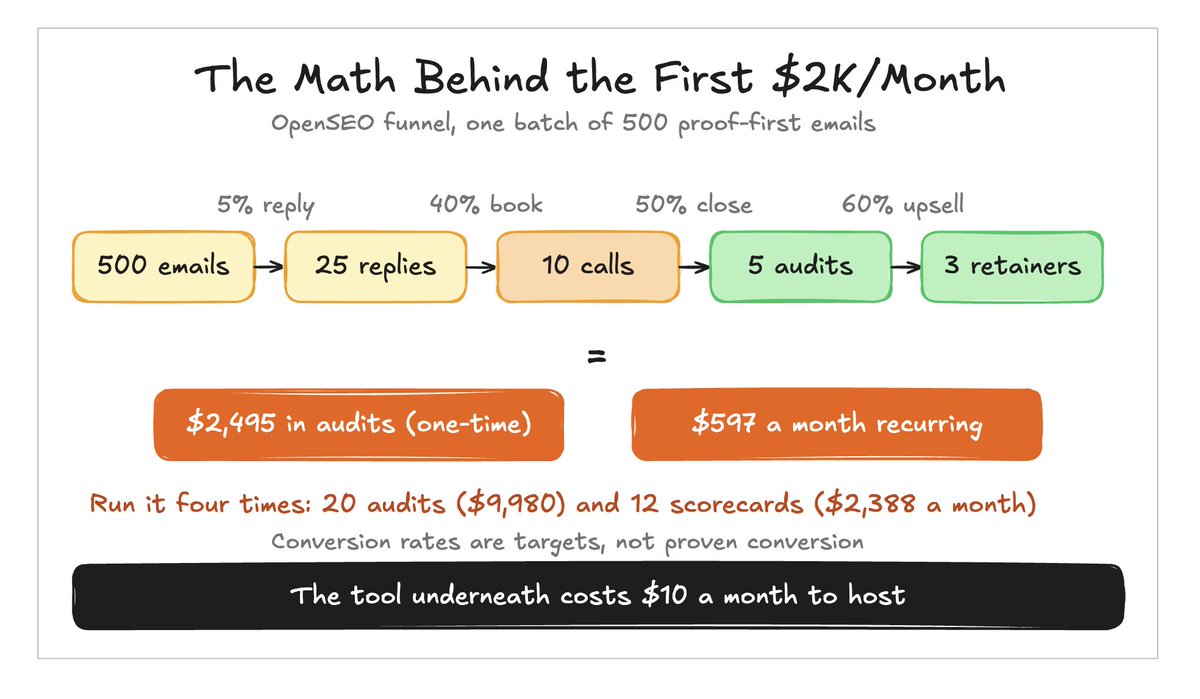
Funnel math, using conservative cold email numbers I'd treat as targets, not proven conversion:
- 500 proof-first emails sent (each with three real findings from OpenSEO)
- 5% reply rate is 25 conversations
- 40% book a call is 10 calls
- 50% close on a $499 audit is 5 audits, or $2,495
- 60% of audit buyers move to the $199 scorecard is 3 retainers, or $597 a month
Run that motion four times: 20 audits ($9,980 one-time) and 12 scorecards ($2,388 a month) on a tool that costs $10 a month to host.
What protects the margin is the time cap. Each scorecard is a two-page report from a tool that already ran the numbers. If a client starts asking "can you also fix it," that's a separate offer with a separate price.
The scorecard is reporting. Fixing is a different invoice.
Getting the first client
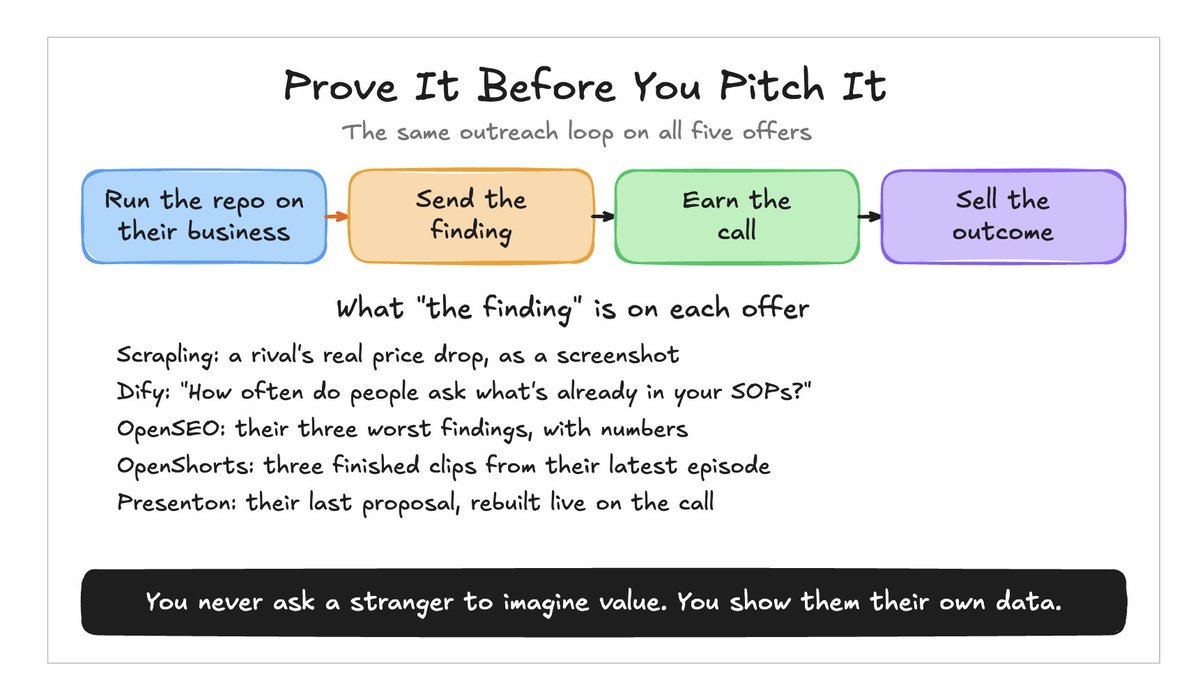
The rule across all five: prove it before you pitch it.
Scrapling sends the rival's price drop. Dify asks the SOP question. OpenSEO sends the three worst findings. OpenShorts sends three finished clips. Presenton rebuilds the last proposal live.
You never ask a stranger to imagine value. You show them their own data.
Here's the OpenSEO version of the email:
COLD EMAIL TEMPLATE (OpenSEO)
Subject: 3 things I found on [DOMAIN]

[First name],

I ran [DOMAIN] through a local search audit this morning. Three things
stood out:

1. [Finding with a number, e.g. "You rank #14 for 'emergency dentist
   [city]' and the #1 result is a competitor 2 miles away"]
2. [Finding with a number]
3. [Finding with a number]

I put together the full report as a two-page scorecard. If you want the
rest of it, reply and I'll send it over. No pitch attached unless you
ask for one.

[Your name]
Send 10 of these tomorrow. The rest go out over the week.
Three ways this model breaks
1. You sell the tool. Say "open-source" or "GitHub" to a dentist and you've lost them. The boundary: the client never hears the repo name until they ask. They buy the scorecard, the handbook bot, the weekly report.
2. You underprice the setup. Dify at $500 setup instead of $1,500 means the same document ingestion work for a third of the money, and the client values it a third as much. The setup fee is where the labor is. Charge for it.
3. You pick three repos at once. Every repo here is a business by itself. Three repos means three cold email motions, three delivery processes, and zero case studies. Pick one. Get to five clients. Then decide whether to add a second.
Three offers, zero clients, is the most common outcome I see.
The first 10 actions I'd take tonight
- Pick one repo. If you have no strong pull, pick OpenSEO.
- Open Claude Code and ask it to install and configure the repo on a small server.
- Connect treg to Claude as an MCP connector.
- Run the treg lead pull prompt above for one metro area. Target 100 companies.
- Run 20 of those domains through OpenSEO and save the three worst findings for each.
- Build the audit as a two-page template so every client gets the same format.
- Send 10 proof-first emails tomorrow morning using the template above.
- Set the prices before the first call: $499 audit, $199 a month scorecard. Don't negotiate on the first client.
- Book every reply into a 20-minute call and walk through their findings on screen.
- After the first audit is delivered, ask for the retainer on the same call.
- At five clients, document delivery so the monthly work stays under 10 hours.
- At ten clients, add a second repo or raise the price.
Final thoughts
None of this requires code. It requires one outcome, a free repo and Claude Code to produce it, and the person who already feels the pain.
Pick one repo tonight. Pull 100 leads with treg. Send 10 emails tomorrow. That's under 30 minutes of actual work, and more than most people reading this will do.
I bundled the repo links, the prompts that build the offer for you, and the cold email templates into a free resource that lives inside AI Operator Hub.
You can access the hub here (free).
Follow me @coreyganim for daily posts on growing an AI services business.
If this was useful, repost it so another operator sees it.
5 Github repos that print $$$
Corey walks through each open-source repo, the service to sell, the buyer, and a realistic price.